What to bring on the Tongariro Crossing
What to bring and wear on the Tongariro Crossing: DOC's gear list, 2 to 3 liters of water, toilet paper, layers, how long it takes and when to start.
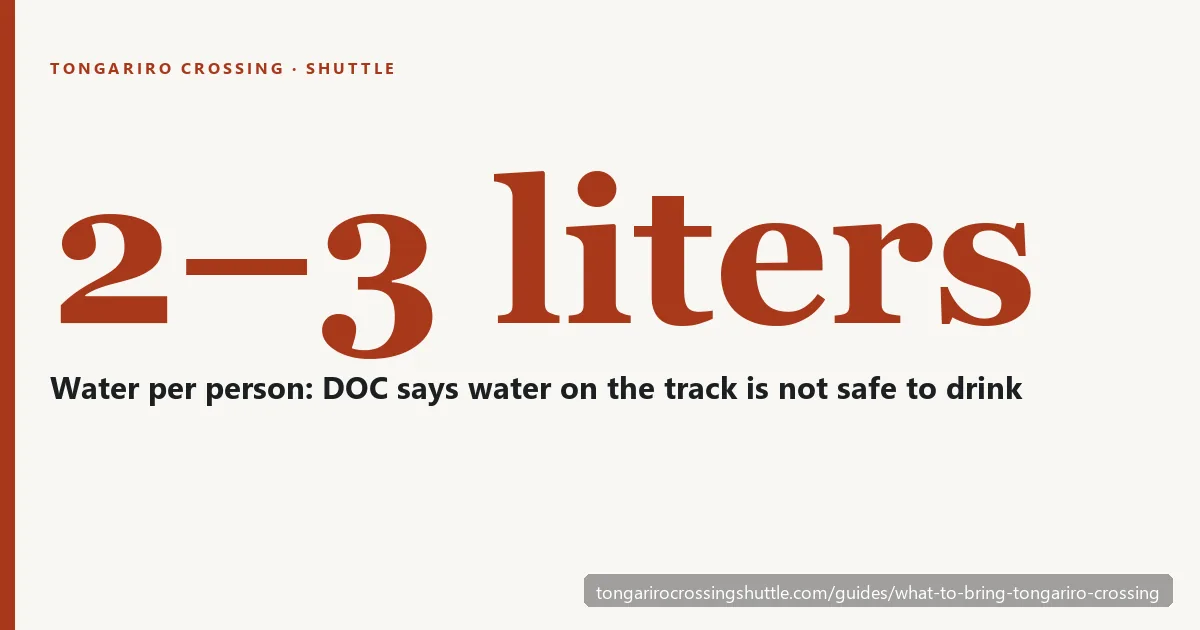
Pack for 7 to 8 hours in the mountains. Carry 2 to 3 liters of water, because DOC says the water along the track is not suitable for drinking. Add food for the whole day, a waterproof jacket and over-trousers, warm wool or synthetic layers, a hat and gloves, sturdy boots, sun protection, a first aid kit, a map and your own toilet paper. That is DOC’s essentials list plus the advice the shuttle operators give. The shuttles get you to the track and back; they do not supply food, water or gear.
Dempsey Buses’ Tongariro Alpine Crossing: Round-Trip Shuttle Service from National Park Village is a typical example. It costs $51 per person (US dollars, checked October 2026), is rated 4.8 from 71 GetYourGuide reviews, and includes a safety briefing. Its own list of what to bring reads food and drinks, hiking shoes, sunscreen, water, rain gear and clothing for the weather.
Check Availability
DOC’s essentials, item by item
DOC lists what every walker should carry on the Crossing. Here is that list with the reason for each item:
- Waterproof raincoat and over-trousers. The Crossing is an alpine environment where conditions can change quickly, as the shuttle listings warn.
- Warm wool or polypropylene clothing. DOC’s winter brochure says Red Crater, the highest point at 1,886 m, is at least 5 °C colder than the start at Mangatepopo and 10 °C colder than Taupō, and you lose a further 2 °C for every 10 km/h of wind. A mild morning at the road end can be a cold one on the ridge.
- A hat and mittens or gloves, for the same reason.
- Sturdy boots. DOC says trainers and sandals are unsuitable. Loose rock on Red Crater is the major slip hazard DOC names, and several shuttle listings name sandals and flip-flops as not allowed. Ruapehu Scenic Shuttles’ listing also bans jeans.
- Food and drink for the whole day.
- A first aid kit.
- Sun protection: sunscreen, a sun hat and sunglasses, which several shuttle listings also put on their lists.
- A map and compass.
Add a daypack to carry it all, a flashlight (on Ruapehu Scenic Shuttles’ and Backyard Tours’ lists) and a charged phone. Operators say cell coverage is patchy, with signal at some points near the Ketetahi end and little over most of the track, so do not count on your phone for navigation. In an emergency, dial 111. In winter, DOC recommends a personal locator beacon, and its winter gear list goes much further; see the winter section of our weather and best time guide.
Water, food and toilets
DOC advises 2 to 3 liters per person and says the water along the track is not suitable for drinking; Active Outdoor Adventures suggests 3 liters. Do not plan to refill from streams or springs on the way. Fill every bottle before you leave your accommodation, because the shuttles do not supply water, and Backyard Tours’ listing names water among the things it does not provide.
Food works the same way: the shuttle listings leave it out. Pack a proper lunch and snacks for 7 to 8 hours. If you are staying in National Park Village, buy them the day before: Adrift, which is based there, notes that the village is small and has no cafes or supermarkets open early in the morning. One exception is Backyard Tours’ round trip from Turangi, which includes a cold drink after the hike.
DOC says there are toilets every 1 to 2 hours along the track. If the queue at Mangatepopo is long, the next toilets are about 1 km on, roughly 20 minutes’ walk. Operators say the toilets have no toilet paper, so bring your own, along with hand sanitizer or tissues as Backyard Tours suggests. Carry your rubbish out: DOC asks walkers to take everything home, especially in the areas recovering from the 2025 fires.
What to wear on the walk
Wear layers you can add and remove as you climb and stop. For a summer crossing, Adrift asks its walkers to bring walking trousers, one light top and two warm top layers (wool, merino, thermals, fleece or softshell), and a waterproof raincoat. For winter, it asks for three warm top layers, thermal longs or walking trousers with over-trousers, a warm hat and gloves. That gives you a good template whoever you travel with.
Start the day with your warm layers in the pack. You warm up on the climb from Mangatepopo, and Red Crater is the coldest point of the walk, so put the layers back on when you stop there. Keep the waterproof jacket at the top of the pack, not under your lunch.
If you are short of a piece of kit, Adrift says personal equipment, footwear and clothing can be hired at its base in National Park Village.
How long the Crossing takes
Plan on 7 to 8 hours in summer and 9 in winter. DOC’s figure for the track is about 19.4 km one way, and operators round it to 20 km. Many shuttle listings quote 6 to 8 hours; treat the lower end as a fast pace.
The profile explains the time. You start at 1,120 m at Mangatepopo, climb to 1,886 m at Red Crater and descend to 760 m at Ketetahi Road, so you do about 800 m of climbing and 1,100 m of descent. DOC rates the fitness needed as high, describes the gradient as steep and undulating, and does not recommend the Crossing for children under 10.
For a shorter day, DOC notes that the first 5.4 km of the Crossing are shared with the Soda Springs Walk, a 2-hour return from Mangatepopo.
What time to start
Start early and finish before dark, as DOC advises. The shuttle timetables set your start. Tongariro Crossing Shuttles publishes departures from National Park Village at 5:45, 7:15, 8:30 and 9:45 am, with returns from Ketetahi from 1:30 pm until 5:30 pm. The shuttles from the private Ketetahi car park run hourly from 6 to 9 am. Confirm the time on your voucher, because timetables change.
Work out your finish before you book. A 7:15 am departure from National Park Village puts you at Mangatepopo roughly 15 to 20 minutes later, and 7 to 8 hours of walking brings you to Ketetahi between about 2:30 and 3:30 pm. That leaves margin before a 5:30 pm last return. A 9:45 am departure can bring you to Ketetahi after 5 pm, close to or past the last van. Active Outdoor Adventures warns that walkers on a return shuttle can be left behind if they do not take an early morning departure.
Reviews show both sides of the timing. One fast walker finished in under 5 hours and faced a two-hour wait for the return van, and a few others waited a long time at Ketetahi. One walker missed the last shuttle and walked back to the car park, partly along the highway. On a park-and-ride, you finish at your own car with no return van to catch, though the private car park closes at 7 pm.
How to prepare in the days before
- Make DOC’s free track booking. DOC recommends it for everyone and requires it for anyone using a shuttle or guided walk, and you show a digital or paper copy to rangers at the car park.
- Check the forecast and DOC’s advisory, and keep a spare day in your plans. Our weather guide explains how DOC and the operators decide.
- Read the cultural requests. Iwi ask visitors not to climb the Ngauruhoe or Tongariro summits and not to touch or enter any waterways, including the alpine lakes. The Ketetahi Hot Springs are on private Ngāti Tūwharetoa land with no public right of access.
- Clean your shoes and gear before you arrive, to keep weeds out of the areas recovering from fire, and stay on the marked track.
- Leave dogs and bikes at home. Flying a drone without a permit is strictly prohibited.
What the shuttles provide, and what they leave out
The return shuttles from town carry you to Mangatepopo and back from Ketetahi. Dempsey adds a safety briefing on its National Park Village shuttle. The park-and-ride listings from Ruapehu Scenic Shuttles and Owhango Adventures include a pre-departure safety briefing, live weather and track updates, a downloadable safety guide and an interactive map, and both exclude food, drinks and hiking gear (our breakdown). Tongariro Expeditions gives you a map and an information sheet. Backyard Tours’ round trip from Turangi includes the optional use of walking poles, and lists water, food, a first aid kit and toilet paper among the things it does not supply.
Guided walks cover more of the kit. Adrift’s guided crossing includes $60 of clothing and footwear hire, plus crampons and ice axes when winter conditions need them (our page).
To choose the shuttle itself, see which Tongariro Crossing shuttle to book.
Frequently asked questions
How long does the Tongariro Crossing take?
Plan on 7 to 8 hours in summer and 9 in winter for the one-way track of about 19.4 km (DOC). Shuttle listings often quote 6 to 8 hours, which is a quick pace.
Can you drink the water on the Tongariro Crossing?
No. DOC says the water along the track is not suitable for drinking. Carry 2 to 3 liters per person from your accommodation.
What should you wear on the Tongariro Crossing?
Sturdy boots, walking trousers, a light top and two warm layers of wool or synthetic fabric, a waterproof jacket and over-trousers, a hat and gloves. DOC says trainers and sandals are unsuitable.
Are there toilets on the Tongariro Crossing?
Yes. DOC says there are toilets every 1 to 2 hours along the track. They have no toilet paper, so bring your own.
Lock In Your Crossing Shuttle
Shuttles run on the mountain forecast, so a booking with free cancellation up to 24 hours ahead keeps a weather day flexible.
Check Availability & Book